Product 05
Activated Alumina
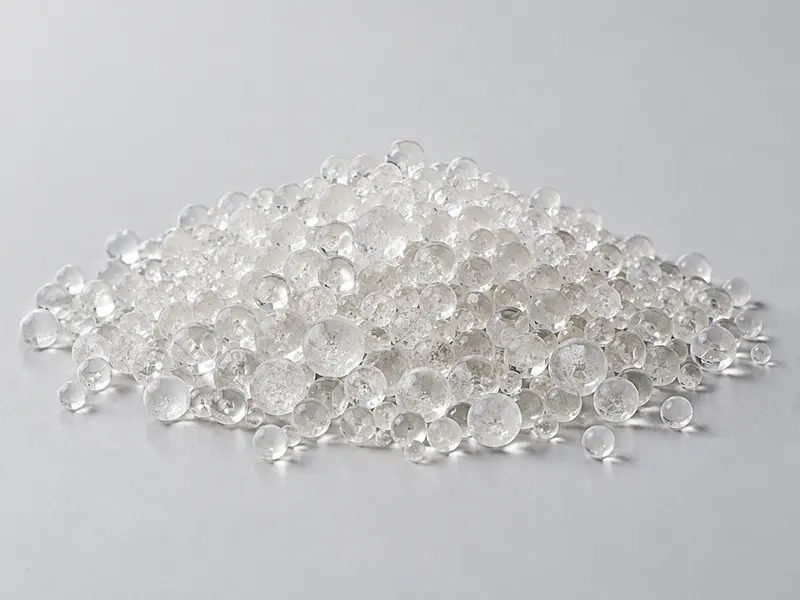
Activated alumina is a highly porous form of aluminium oxide, usually supplied as hard spherical balls. Its internal surface holds water vapour and certain dissolved ions, which makes it a common desiccant and a well-known medium for removing fluoride from water.

- Form
- Spherical balls
- Grades
- Multiple, matched to application
- Documentation
- Available on request
- Packaging
- Confirmed with each quote
Quick answer
What is activated alumina used for?
Activated alumina is a porous form of aluminium oxide, usually supplied as hard balls. It is used as a desiccant to dry compressed air and industrial gases, and in packed beds to reduce fluoride in drinking water. Exhausted beds can be regenerated.
Product overview
In compressed air and gas dryers, activated alumina adsorbs moisture as the gas passes through a packed bed, and the bed is regenerated by heat or a purge of dry air. In water treatment, activated alumina beds are used to reduce fluoride in drinking water.
Ball size and grade are chosen for the vessel, flow and application. Share your requirement and we will confirm a suitable grade.
How an activated alumina dryer works
- 01
Adsorb
Wet air or gas passes through the bed; moisture is held on the alumina.
- 02
Saturate
Over the cycle, the bed approaches its moisture capacity.
- 03
Regenerate
The second bed takes over while this one is dried by heat or a dry purge.
- 04
Return to service
Beds switch, so drying continues without interruption.
Key applications
Compressed air drying
Desiccant beds in heatless and heated regenerative dryers.
Gas drying
Moisture removal from industrial gases in packed beds.
Fluoride removal
Adsorbent beds for reducing fluoride in drinking water.
Adsorbent and support media
Guard beds and support layers in adsorption systems.
Activated alumina or silica gel?
| Activated alumina | Silica gel | |
|---|---|---|
| Material | Aluminium oxide | Silicon dioxide |
| Usual form | Hard spherical balls | Beads |
| Typical uses | Compressed air and gas dryers, fluoride removal | Packaging, instrument and breather drying, gas drying |
Industries served


Available grades and specifications
Grades are selected for your application. Parameters commonly specified for activated alumina include:
- Ball size
- Surface area
- Bulk density
- Crush strength
- Loss on ignition
Choosing a grade: what to tell us
- Required dew point or fluoride target
- Temperature and pressure
- Regeneration method
- Ball size for the vessel and flow
Technical specifications available on request.
Tell us your application and the specification you work to, and we will share details for suitable grades.
Packaging
Packaging depends on the grade and quantity and is confirmed with each quote. Let us know your preferred pack size and handling requirements when you enquire.
Technical information
Technical data sheets and supporting documentation for each grade are shared on request.
Frequently asked questions
What is the difference between activated alumina and activated carbon?
Activated alumina is aluminium oxide and attracts water and some polar compounds and ions such as fluoride. Activated carbon is carbon and is best at adsorbing organic compounds. They solve different problems.
Can activated alumina be regenerated?
Yes. In drying applications it is regenerated by heating or purging with dry air. In defluoridation, beds are commonly regenerated chemically.
Which ball size should I use?
It depends on the vessel and flow. Smaller balls offer faster uptake; larger balls give lower pressure drop. We will suggest a size once we know your system.
Request product information
Share your application and requirement for activated alumina. Our team will help you identify a suitable grade.
Prefer to talk? +91 98205 22171